

Insights
Dec 25, 2025
News
Enterprise
Artificial Intelligence
Machine Learning
NewDecoded
6 min read
Image by Amazon
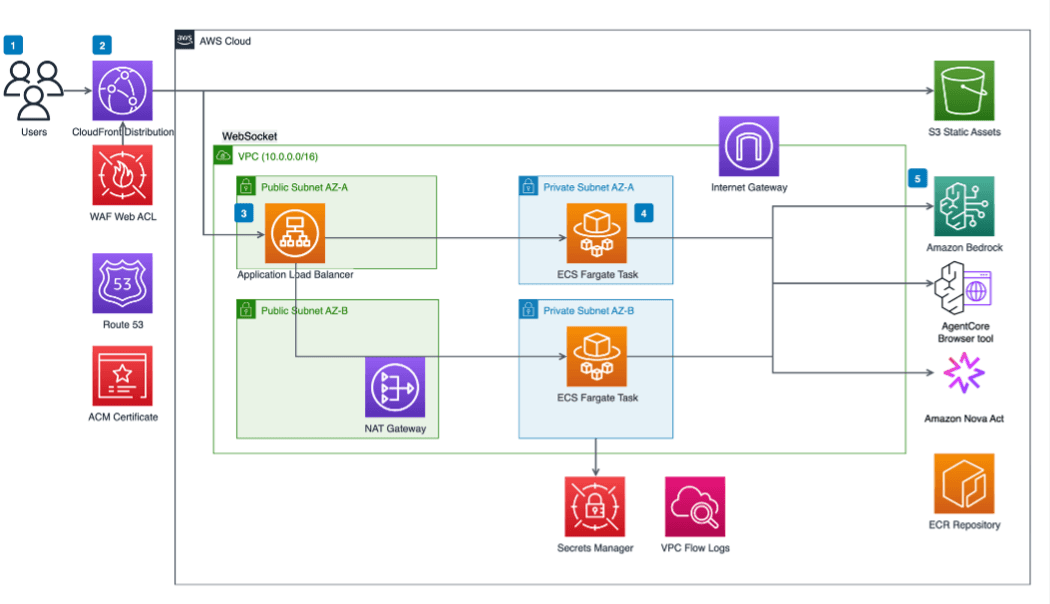
Amazon Web Services has launched a new framework for AI-driven browser automation to help organizations handle manually intensive web tasks. By integrating Amazon Nova Act and Strands agent with the Amazon Bedrock AgentCore Browser, the system navigates dynamic websites that lack native API access. This shift aims to reclaim the significant portion of worker time currently lost to repetitive data entry and constant system switching.
The solution moves beyond traditional robotic process automation by utilizing a hybrid approach to web navigation. It combines the visual understanding of the Nova Act model with the structural precision of the Strands and Playwright platform. This ensures that automation remains resilient even when website layouts change or buttons are moved by web developers.
These AI agents can perform a variety of complex functions such as purchase order matching and employee onboarding across disparate identity and management systems. The system utilizes a secure, cloud-based browser environment that maintains session isolation while providing real-time monitoring for administrators. This structure allows businesses to automate workflows that were previously considered too dynamic for standard software bots.
AWS has included a human-in-the-loop feature to manage specific exceptions that might stop a fully automated process. If an agent encounters a captcha or an out-of-stock item, it can immediately notify an operator through a live web view. The human can then resolve the specific roadblock before passing control back to the AI to complete the remaining steps.
Every action taken by the system is logged and recorded to ensure full auditability for corporate compliance and security through AWS CloudTrail. The architecture supports parallel execution of multiple tasks with priority queuing and automatic retry logic for any temporary failures. This scalability helps organizations manage high volumes of work without the need for constant manual oversight or script maintenance.
Amazon Web Services has introduced a new approach to enterprise automation that allows AI agents to navigate web browsers like humans. The solution integrates Amazon Nova Act and Strands agents within the Amazon Bedrock AgentCore Browser environment. This framework is specifically designed to handle complex workflows across websites that lack modern programming interfaces or APIs.
The initiative addresses a persistent gap in business productivity where workers spend significant time manually transferring data between disparate systems. Traditional robotic process automation is often too brittle for this work because it fails when a website undergoes even minor layout updates. By contrast, these new agents use visual reasoning to understand screen elements, making them far more resilient to change.
To ensure enterprise-grade security, the system runs in an isolated cloud browser environment rather than on a user's local machine. All activity is logged via AWS CloudTrail and recorded to provide a clear audit trail for compliance purposes. This infrastructure allows companies to scale their automation efforts safely using containerized tasks that adjust to real-time demand.
One of the standout features is the human-in-the-loop capability which uses real-time streaming to alert operators when an agent gets stuck. If an agent encounters a challenge like a CAPTCHA or an out-of-stock item, a human can take over the session momentarily. Once the obstacle is cleared, control is passed back to the AI to finish the remaining steps of the workflow.
This technology is currently being demonstrated through an e-commerce order management use case where agents process purchases across multiple retailer sites. Instead of writing custom scripts for every individual store, the AI uses general instructions to identify products and fill out shipping forms. The system can even handle complex decision points and navigate through multi-step checkout processes autonomously.
The orchestration is powered by the Strands framework which utilizes the Model Context Protocol to manage agent interactions. This standard helps ensure that the tools remain interoperable and reduces the risk of being locked into a single proprietary ecosystem. The result is a more flexible platform for automating the highly dynamic last mile of enterprise business processes.
The Evolution of Cognitive Workflow Management
This release marks a fundamental shift from simple robotic assistants to autonomous background agents that can handle the messiness of the public web. By integrating vision-capable models with secure cloud infrastructure, AWS is directly targeting the weaknesses of older automation tools that were prone to breaking.
The use of industry-standard protocols like the Model Context Protocol suggests that the next phase of enterprise AI will focus on interoperability and reliable autopilot execution for legacy systems that previously required human swivel-chair work.