 NewDecoded

Motif Technologies released Motif 3 as an openly downloadable mixture-of-experts language model with about 314 billion total parameters and 13.2 billion activated per token. The model card on Hugging Face lists the release under the MIT License, with no access request required.
According to the card and the accompanying arXiv technical report, Motif 3 is a decoder-only MoE built in-house rather than a re-parameterization of an existing open architecture. It uses Grouped Differential Latent Attention, Expert-Specific PolyNorm activations, modified manifold-constrained hyper-connections, and a multi-token prediction head for self-speculative decoding. Pretraining covered roughly 12.5 trillion tokens, with added emphasis on Korean, reasoning, legal, and financial data.
Sparse experts, long context, agentic scores
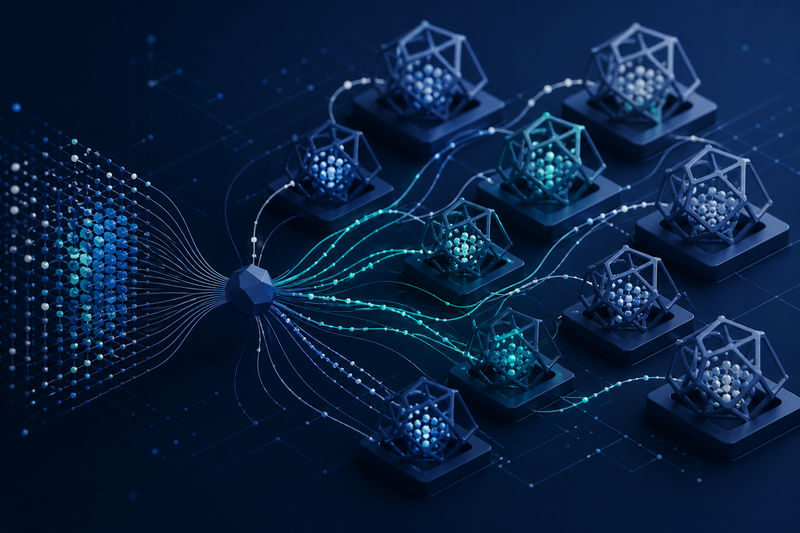
The published summary describes 384 routed experts with eight activated per token plus one shared expert, a native 256K context window, and a 220,160-token vocabulary. Motif 3 reports strong results on agentic and terminal-style evaluations in the model card, including Terminal-Bench 2.1 at 74.9 and SWE-Bench Verified at 76.2, while remaining competitive on coding and knowledge benchmarks against other large open-weight systems.
An NVFP4-quantized checkpoint is also available for smaller memory footprints, and Motif published deployment guidance for a public vLLM fork plus a Motif-specific Docker image. The company points builders to a training-example repository for architecture and distributed training details.
Decoded Take
The commercially meaningful signal is the license. A Korean lab putting a 314B-class MoE under MIT lowers the friction for sovereign and enterprise forks that want open weights without non-commercial traps. Motif 3 will still live or die on serving cost, tool-use reliability, and Korean-language quality outside the leaderboard. Watch whether integrators standardize on the Motif vLLM path, and whether other national model programs answer with equally permissive final releases.